
Anantarakshakaḥ Samyojanam
Anantarakshakaḥ Samyojanam—Organization Charter
Charter of the Anantarakṣakaḥ Samyojanam
The Anantarakṣakaḥ Samyojanam — Union of the Infinite Protectors — is a sacred fellowship founded by Seven Guardian Species and Four Eternal Guardians, united not for dominion but for guardianship. Born in ages when conquest and greed fractured creation, it stands as covenant, not empire; as shield, not crown.
At its heart are the Council of Eleven — four Eternal Guardians embodying Wealth, Wisdom, Order, and Spirit, and seven Species Leaders embodying the pillars of Ocean, Fire, Wind, Void, Earth, Sky, and Nature. Together they serve as stewards of law, balance, and provision. In times of peril, defense is entrusted to the Sapta-Senāpatis, Seven War Commanders drawn from each species, bound by oath: no conquest, no spoils, and duty to rebuild. Council and Command together form the Eighteen Pillars of the Union, vision joined with execution.
The Union sanctifies its wealth as service, not profit, through Service Dominions dedicated to food, medicine, shelter, metals, gems, elixirs, defense, transport, construction, peacekeeping, and truth-liberation. All resources flow at the lowest cost permitted by creation, ensuring sustenance and healing for every being.
Membership is open to all who renounce conquest and swear the eternal vow. Every guardian is bound by the Code of Conduct: to protect the weak, provision without hoarding, restore the broken, and preserve dignity without prejudice.
Its authority is sacred, not sovereign, extending wherever balance falters or innocents cry. Its wars are restrained by ritual, consecrated under the Circle Unbroken, and followed always by restoration. No empire shall it become; no conquest shall it pursue.
Thus the Union proclaims: its breath is service, its heartbeat protection, its soul the dignity of all life. By vow eternal, the Anantarakṣakaḥ Samyojanam shall endure for all time.
Anantarakshakaḥ Samyojanam - “The Union of the Infinite Protector”
1. Founding Vision & Preamble:
Before the countless stars bore witness, when realms trembled beneath the weight of conquest and hunger, seven great lineages lifted their gaze to the Infinite and swore a vow. From ocean and flame, from wind and void, from earth and sky, from the voice of nature itself, they rose together and declared:
“There shall be no dominion but guardianship. There shall be no hunger but provision. There shall be no despair but restoration.”
From the depths of the sea came the Sāgarya, storm-born of mercy and wrath, who cradle life in tides yet summon fury against oppression.
From the eternal flame stood the Agnirakṣhak, wardens of the purifying blaze, who burn away corruption and kindle courage.
From the freedom of the wind rose the Vāyusūtra, bearers of storm and breath, who scatter chains and breathe liberty.
From the vast stillness of the void appeared the Antarikṣhins, threshold-keepers, who guard the silence between worlds.
From the roots of the earth stood the Bhūrakṣhak, colossal anchors of stone and soil, whose strength steadies creation.
From the radiance of the heavens shone the Suvarṇin, golden sovereigns, who scatter shadow, devour poison, and bind truth with light.
From the voice of creation itself awoke the Prakṛtisvara, wielders of the six sacred substances, who heal, shield, and preserve balance.
These Seven, though distinct, did not rise for their own dominion. They rose as pillars of existence, equal and interwoven, guardians not of themselves but of all life.
Yet even guardians may falter. To keep might from turning to tyranny, and covenant from bending into conquest, Four Eternal Guardians joined their vow:
Arthādhipa → Guardian of Wealth & Provision.
Mantrādhishī → Guardian of Wisdom & Counsel.
Ritvāhana → Guardian of Order & Justice.
Ātmadhārā → Guardian of Spirit & Essence.
Together the Seven and the Four forged the covenant of the Anantarakṣakaḥ Samyojanam — not an empire of crowns, but a fellowship of guardianship; not a dominion of rule, but a union of service.
We proclaim:
That strength is not in conquest, but in defense without cruelty.
That wealth is not in hoarding, but in sharing without measure.
That wisdom is not in dominion, but in counsel without chains.
That spirit is not in bondage, but in essence unbroken.
So let it be known across all realms: This Union is the Protector without End. This Covenant is the Hand that heals, not the hand that enslaves. This Fellowship is the light that no shadow may overcome. By oath eternal, by vow unbroken, by service unceasing — Anantarakṣakaḥ Samyojanam shall endure for all time.
2. Name, Symbol & Identity
The Name: The fellowship bears the name Anantarakṣakaḥ Samyojanam — The Union of the Infinite Protectors. This name is not chosen lightly, nor is it ornament. It is a declaration, a vow, and a remembrance of purpose.
Ananta → that which is endless, eternal, without limit; the reminder that guardianship is unceasing, bound not by years but by existence itself.
Rakṣakaḥ → the guardians, protectors, and stewards; those who stand not for conquest but for defense, not for rule but for balance.
Samyojanam → the covenant, the binding together; the eternal coordination of diverse beings into one purpose, many voices joined into one vow.
The name itself teaches: we are unending in duty, protective in nature, and united in service.
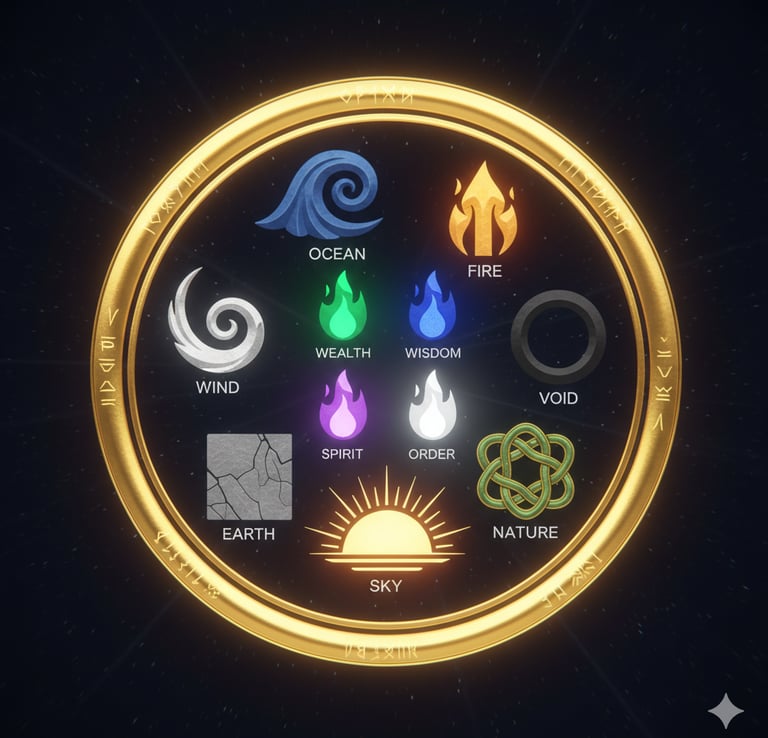
The Sacred Symbol: At the heart of the Union stands the Circle Unbroken, the sacred seal and banner of the covenant. It is not drawn in idle craft, but shaped as instruction to all who bear it.
The Seven Pillars set within the Circle signify the Guardian Species, each etched with its elemental truth:
Ocean (Sāgarya) → Spiral of tides, storm and renewal.
Fire (Agnirakṣhak) → Flame rising upward, blaze and purification.
Wind (Vāyusūtra) → Spiral of breath, freedom and tempest.
Void (Antarikṣhins) → Hollow ring, stillness and threshold.
Earth (Bhūrakṣhak) → Square foundation, root and strength.
Sky (Suvarṇin) → Radiant arc, light and truth.
Nature (Prakṛtisvara) → Woven pattern, the six sacred substances in balance.
The Four Eternal Flames burn at the center, not above the Seven, but among them — for principles exist only in harmony with form:
Wealth — provision without greed, the sustenance of all.
Wisdom — counsel without bondage, the voice of discernment.
Order — justice without tyranny, the keeper of balance.
Spirit — essence without shadow, the breath of dignity.
The Ring of Infinity encircles all, a line without break, without beginning or end. It is the reminder that guardianship is timeless, that the vow cannot be exhausted, that unity once broken must always be restored.
Thus the symbol speaks: the Seven are nothing without the Four, the Four are nothing without the Seven, and all are bound within eternity.
The Identity: The identity of the Union is not in crowns, titles, or dominion. Its identity is in vow and service.
We do not rule; we guard.
We do not conquer; we preserve.
We do not hoard; we distribute.
We do not enslave; we restore.
Every member who bears the Circle Unbroken is recognized not by bloodline nor by power, but by vow. To carry this mark is to be named Protector Without End, custodian of peace, steward of balance, and servant of the dignity of all life. The Union’s identity rests on this truth: its breath is service, its heartbeat protection, its soul the dignity of creation.
3. Purpose, Objectives & Core Values
The Purpose: The Anantarakṣakaḥ Samyojanam exists not for dominion, but for guardianship. Its purpose is to shield creation, restore balance, and preserve dignity. It breathes service, not conquest; it lives for restoration, not expansion.
To guard the weak against oppression.
To preserve the balance of realms and elements.
To restore what is broken by greed, violence, or neglect.
To ensure that no being is abandoned, and no world is forgotten.
The Union is the Protector Without End, whose strength exists only to serve life.
The Objectives: To fulfill its purpose, the Union sets forth eternal objectives:
Preservation of Balance
To uphold harmony among earth, ocean, flame, wind, void, sky, and nature.
To ensure that no element consumes another, and no race overwhelms the whole.
Protection of Realms
To act as shield when violence, tyranny, or conquest threaten.
To guard borders, thresholds, and sanctuaries across the cosmos.
Provision for All
To ensure that food, medicine, shelter, and resources reach all beings at the lowest cost creation allows.
To sanctify service as higher than profit, and sustenance as higher than possession.
Restoration of What Is Broken
To rebuild cities, sanctuaries, and lands shattered by war or disaster.
To heal dignity where it has been stolen, and renew hope where it has been crushed.
Guardianship of Truth
To scatter deception and illusion that bind beings in ignorance.
To ensure wisdom flows freely, not chained to dominion or greed.
The Core Values: The Union holds these vows as eternal and unbreakable. They are the foundation of its law and the measure of its every act:
Equality → No species, race, or being shall claim higher station. All who bear the vow are guardians alike.
Service → Wealth and power exist only to sustain, not to hoard. Service is the highest offering.
Guardianship → Arms are raised not for conquest, but only to shield and defend.
Truth & Wisdom → Counsel is given without bondage, and light is offered without chain.
Restoration → To rebuild what is broken, to heal what is wounded, to restore what is lost.
Unity Eternal → Seven Pillars and Four Flames bound as one; many voices, one vow; many powers, one purpose.
The Union declares: That conquest shall never be its path. That greed shall never be its root. That tyranny shall never be its form. That service shall always be its breath. So long as the Seven and the Four endure in unity, these values shall remain unbroken, and the Union shall remain eternal.
4. Scope of Authority & Jurisdiction
The Anantarakṣakaḥ Samyojanam does not claim dominion over thrones or crowns, nor rule over empires or realms. Its authority is sacred, not sovereign — given not for conquest, but for guardianship. It extends wherever suffering is unhealed, wherever balance is broken, wherever oppression darkens life. Its jurisdiction is not of territory, but of vow.
Governance & Stewardship — The Council of Eleven: At the heart of the Union stands the Council of Eleven, charged with stewardship, law, and the balance of the whole.
Four Eternal Guardians → embody the cosmic principles of Wealth, Wisdom, Order, and Spirit.
Seven Guardian Species Leaders → embody the elemental–spiritual pillars of existence: ocean, fire, wind, void, earth, sky, and nature.
Together they form the Council of Eleven, entrusted with:
Vision and direction of the Union.
Preservation of law and values.
Daily governance of service dominions and assemblies.
Stewardship of vows so that none may falter.
The Council does not rule as monarchs, but serves as stewards. Authority here is coordination, not dominion.
Martial Arm — The Sapta-Senāpatis: In times of peril, when words no longer suffice and defense must be raised, authority passes to the Sapta-Senāpatis — the Seven War Commanders, one drawn from each Guardian Species.
They form the martial arm of the Union, empowered to:
Direct defense and protection of realms.
Lead forces into battle when guardianship demands it.
Stand as shield against conquest and corruption.
They are bound by sacred vows:
No conquest. Arms shall never be raised to expand dominion.
No spoils. Nothing seized in war may be kept or claimed.
Duty to rebuild. What is broken by war must be restored by the Union.
The Senāpatis act with full power in war, yet always under the eternal law of the Union’s vows.
Symbolic Geometry — The Eighteen Pillars: Together the Council of Eleven and the Sapta-Senāpatis form the Eighteen Pillars of the Union.
Council of Eleven → vision, governance, and stewardship.
War Command of Seven → execution, defense, and protection.
Eighteen together → strategy bound to action, law bound to arms, vow bound to deed.
Thus the Union is whole: one body, many pillars; one oath, many voices. Its authority is not crown or empire, but the eternal covenant of guardianship.
5. Membership & Eligibility
The Anantarakṣakaḥ Samyojanam is not bound by blood, lineage, or race. Its gates are not closed to any realm, or form of being. Membership is determined not by birth, but by vow; not by power, but by service.
Eligibility:
Any being of creation — mortal, celestial, elemental, or otherwise — may seek entry, provided they:
Renounce conquest, greed, and dominion.
Swear service to guardianship, protection, and restoration.
Accept equality with all members, regardless of origin or station.
Submit to the laws and values of the Union.
No lineage, however exalted, holds exclusive right of entry.
No being, however humble, is denied if their vow is true.
The Oath of Membership: Every initiate is bound by a sacred vow spoken before the Circle Unbroken:
To guard the weak and forsake conquest.
To provision without hoarding.
To counsel without bondage.
To preserve dignity where it falters.
To restore balance where it breaks.
This oath is not mere speech, but a covenant written in the lifeblood of the cosmos. To break it is to break with the Union itself.
Paths of Belonging
Council & Leadership
Reserved for the Seven Guardian Species and the Four Eternal Guardians.
Seats inherited or entrusted by lineage, tradition, or sacred designation.
Assemblies & Service Circles
Open to all other members, regardless of origin.
Voice is granted in counsel, and role is given in service.
Merit, wisdom, and dedication determine responsibility.
Martial Path
From among the Seven Species are chosen the Sapta-Senāpatis.
Other members may serve as soldiers, healers, or restorers under their command.
Loss of Membership: Membership may be stripped if:
A vow is broken in conquest, greed, or betrayal.
Service is abandoned for self-interest.
A member raises arms against the Union’s own covenant.
Such expulsion is not vengeance, but the necessary act of preservation.
Thus membership is sacred: open to all in vow, equal to all in dignity, firm in law, eternal in service.
6. Organizational Structure & Divisions
The Anantarakṣakaḥ Samyojanam is not an empire of thrones but a fellowship of service, shaped into clear divisions so that vow becomes order, and order becomes living guardianship. Its structure rests upon three sacred pillars: Governance, Martial Command, and Service.
Governance & Stewardship — The Council of Eleven: The highest seat of vision and balance.
Composition:
Four Eternal Guardians → principles of Wealth, Wisdom, Order, Spirit.
Seven Guardian Species Leaders → pillars of Ocean, Fire, Wind, Void, Earth, Sky, Nature.
Mandate:
Stewardship of law, values, and vows.
Governance of assemblies and service dominions.
Judgment in matters of justice and preservation of balance.
Guidance to the Martial Arm in times of peril.
The Council does not rule as kings, but serves as stewards. Its authority is coordination, not dominion.
Martial Command — The Sapta-Senāpatis: The shield-arm of the Union, empowered in war and defense.
Composition:
Seven War Commanders, one chosen from each Guardian Species.
Mandate:
Defense of realms when threatened.
Leadership of all martial forces in conflict.
Execution of the Union’s vow in times of battle.
Sacred Restraints:
No conquest may be pursued.
No spoils may be kept.
All that is broken must be restored.
The Sapta-Senāpatis hold full power in war, yet remain bound by the covenant of guardianship.
Service & Provision — The Dominions of the Union: The living arm of sustenance and rebuilding.
Composition:
Thirteen Service Dominions, each dedicated to a vow of provision — food, medicine, shelter, metals, gems, elixirs, transport, construction, weapons for defense, peacekeeping, restoration, truth-liberation, and ocean-gifts.
Mandate:
To provision all beings at the lowest cost permitted by creation.
To ensure sustenance, healing, and resources are shared, never hoarded.
To rebuild what war or disaster has destroyed.
Here service is sanctified as higher than profit; provision is held above possession.
Assemblies & Service Circles: The voice of the wider fellowship.
Composition:
Members beyond the Council and Command, gathered in circles of counsel and service.
Mandate:
To advise, deliberate, and participate in the work of guardianship.
To ensure the Union remains open to every being who bears the vow.
The Eighteen Pillars of the Union: Together the Council of Eleven and the Sapta-Senāpatis form the Eighteen Pillars — vision joined with action, law joined with arms, stewardship joined with guardianship. Around them stand the Service Dominions and Assemblies, extending the covenant into every realm.
Thus the Union is whole: strategy, execution, and service, bound in eternal harmony.
7. Leadership, Governing Body & Roles
The Anantarakṣakaḥ Samyojanam is guided not by monarchs or tyrants, but by stewards of vow. Leadership is sacred burden, not privilege; responsibility, not dominion. The governing body is entrusted to preserve balance, guard the covenant, and guide the Union’s many arms with wisdom and restraint.
The Council of Eleven — Governing Body: The supreme seat of guardianship and stewardship.
Four Eternal Guardians → embodiments of principle:
Anira Vardhanī, Arthādhipa, Lady of Wealth – Keeper of all resources, she ensures just distribution of shelter, food, and sustenance. Her role is to safeguard abundance against hoarding, and to make prosperity flow to every realm without prejudice.
Satyavān Jyotiṣmat, Mantrādhishī, Lord of Wisdom – Embodiment of discernment, he counsels the Union with clarity and foresight. His role is to unveil truth, dispel illusion, and guide decisions without binding them in chains of control.
Ritvāhana Dharmajit, Vyavasthādhipa, Lord of Order – Bearer of justice, he upholds the laws that keep the Union from faltering. His role is to resolve disputes, preserve harmony among species, and ensure no power bends the covenant to tyranny.
Ātmaya Nisvarī, Ātmadhārā, Lady of Spirit – Guardian of essence, she embodies the flame within all life. Her role is to preserve dignity, strengthen faith, and remind all guardians that their vow is not of power but of soul.
Seven Guardian Species Leaders → embodiments of existence: Ocean, Fire, Wind, Void, Earth, Sky, and Nature.
Samudra Rāvant, Sāgarya, Ocean Guardian – Lord of tides and storms, he embodies both nurture and wrath of the sea. His role is to protect life’s cradle in the waters and unleash fury only when realms are threatened.
Vahni Rakṣitī, Agnirakṣhak, Flame Guardian – Lady of the eternal blaze, she burns corruption and kindles courage. Her role is to wield fire not as destruction, but as purification, lighting the path of justice.
Anila Sūtradhār, Vāyusūtra, Wind Guardian – Lord of storm and breath, he scatters chains of oppression and breathes freedom. His role is to guard the liberty of realms and keep life’s breath unbroken.
Śūnya Dhvanī, Antarikṣhinī, Void Guardian – Lady of the silence between worlds, she watches thresholds unseen. Her role is to guard the hidden paths, preserve stillness, and keep balance where earth meets sky, and life meets beyond.
Dhara Sthirajit, Bhūrakṣhak, Earth Guardian – Lord of roots and stone, he anchors creation with steadfast might. His role is to preserve stability, shelter the weak, and serve as the Union’s unshakable foundation.
Svarna Vyomeśvarī, Suvarṇinī, Sky Guardian – Lady of golden light, she scatters shadows and binds truth with radiance. Her role is to cleanse poisons of deceit, protect the heavens, and keep the cosmos illumined.
Prakṛta Svarajit, Prakṛtisvara, Nature Guardian – Lord of the six sacred substances, he heals, shields, and balances creation. His role is to preserve harmony between elements, and to wield nature as cure, armor, or weapon for the Union’s vow.
Mandate
To preserve the eternal vows of the Union.
To govern assemblies, dominions, and councils of service.
To safeguard the harmony between Seven Species and Four Principles.
To guide the Martial Arm in times of war, ensuring that battle never strays into conquest.
The Council speaks with one voice, bound by sacred concord. No single guardian may command alone, for unity is law.
The Sapta-Senāpatis — Martial Command: The Seven War Commanders, one from each Guardian Species, stand as the Union’s shield in times of peril.
Seven War Commanders → embodiments of principle:
Mārīcī Samudrāntī, Ocean Commander – Lady of the tides, she commands the seas in battle. Her role is to shield realms with tidal walls, wielding the sea’s fury only in defense of life.
Kālikā Vahniveśī, Flame Commander – Lady of embers, she bears the fire as weapon and purifier. Her role is to turn battlefields into cleansed ground, burning only corruption, never conquest.
Saṅgrāhī Prakṛtidhārā, Nature Commander – Lady of the wild bond, she summons forests, roots, and essences as shield and spear. Her role is to defend with the living world itself, turning wilderness into sanctuary.
Vāyudhvaja Lokapāla, Wind Commander – Lord of the gale, he leads swift strikes, scattering armies like leaves. His role is to preserve freedom of realms by cutting chains of domination.
Pṛthvīsthā Vajrabala, Earth Commander – Lord of stone and fortress, he anchors armies with impenetrable defense. His role is to shield cities, raise bastions, and stand as immovable wall before invaders.
Sūryavīra Dyausnetra, Sky Commander – Lord of radiant flight, he commands aerial hosts across stars. His role is to blind shadows with light, bringing clarity and strength to allied forces.
Śūnyamūrti Antarālajit, Void Commander – Lord of silence, he directs hidden paths and sudden strikes. His role is to protect unseen thresholds, ensuring enemies fall before they cross into sacred ground.
Mandate
To lead defense when realms are threatened.
To direct martial forces with honor and restraint.
To act swiftly in war, yet always bound to the covenant of no conquest, no spoils, and duty of restoration.
The Senāpatis do not govern; they execute the will of the Union when words give way to arms.
The Service Dominions — Arms of Provision: Leadership also flows through the Thirteen Service Dominions, each overseen by stewards chosen for skill, merit, and vow.
Mandate
To provision life — food, medicine, shelter, resources, and truth.
To sanctify labor as service, never as profit.
To rebuild what is broken and heal what is wounded.
Their leaders are not lords of trade but custodians of need, servants of the vow that none shall hunger, despair, or be abandoned.
Assemblies & Service Circles — The Broader Fellowship: Every member beyond the high seats is granted voice in Assemblies and role in Service Circles.
Mandate
To deliberate, advise, and keep leadership accountable.
To share wisdom from every realm and every being.
To ensure the Union remains open, inclusive, and unbroken.
In this way, leadership flows not only from above but also from within — a circle where guardianship is shared by all.
Sacred Roles of Leadership: All leaders, regardless of seat, are bound to these eternal roles:
Steward → to preserve the vow.
Protector → to defend without cruelty.
Healer → to restore what is broken.
Servant → to place duty above self.
Leadership in the Union is not privilege; it is the heaviest burden of service.
8. Decision-Making & Conflict Resolution
The Anantarakṣakaḥ Samyojanam does not rest authority in a single hand, nor allow power to be wielded without concord. Decisions are the weaving of many voices into one thread, and conflicts are resolved not by might, but by law and vow.
Decision-Making — The Sacred Concord
Council of Eleven
All matters of governance, service, and law are entrusted to the Council of Eleven.
Decisions are reached through sacred concord — each voice heard, each principle weighed, until unity is found.
Where discord arises, it is the role of:
Mantrādhishī (Wisdom) → to weave voices into counsel.
Ritvāhana (Order) → to settle the final path when counsel cannot.
No decision may stand if it violates the eternal vows of the Union.
Sapta-Senāpatis
In times of battle, the Seven War Commanders hold full authority to act swiftly and decisively.
Yet even in war, their decisions are bound by vow: no conquest, no spoils, and duty to rebuild.
They answer to the Council of Eleven, but are granted autonomy on the battlefield.
Assemblies & Service Circles
Members beyond the high seats hold advisory voice in Assemblies.
Their counsel is recorded, deliberated, and weighed by the Council.
Thus even the least-ranked guardian may shape the Union’s path.
Conflict Resolution — The Path of Justice
Internal Disputes
When conflict arises between members, it is first brought to Service Circles, where reconciliation is sought through dialogue.
If unresolved, it ascends to tribunals of the Council, judged by the Eternal Guardians of Wisdom and Order.
Expulsion or penance may be declared only when vows are broken beyond repair.
Between Species or Divisions
Disputes between Guardian Species or Service Dominions are heard before the full Council of Eleven.
No single race or dominion may overrule another; balance is preserved by unity.
Between Realms
When realms beyond the Union bring grievances, mediation is the first path.
Only if mediation fails, and guardianship demands action, may the Martial Arm be mobilized — always with the consent of the Council.
Safeguards Against Tyranny
No leader may act as sole authority.
No decision may be passed that violates the eternal vows.
No war may be declared for conquest or profit.
All conflicts must be settled in the spirit of guardianship, not dominion.
9. Imperial Wealth & Service Dominions
The Anantarakṣakaḥ Samyojanam sanctifies wealth not as possession, but as provision. Resources are not to be hoarded, nor industries bent to profit. All dominions of labor are consecrated as Service Dominions, each bound by vow to sustain creation at the lowest cost permitted by existence. This is the Union’s Imperial Wealth: not treasure in vaults, but abundance placed in service of all.
Principles of Imperial Wealth
Wealth is service. Prosperity exists to flow, not to stagnate.
Labor is sacred. Every craft, every dominion, is vow-bound to provision.
Profit is forbidden. The measure of industry is not gain, but healing, nourishment, and balance.
Provision is universal. No realm, no being, shall be denied the gifts of sustenance.
The Service Dominions of the Union
Agriculture → Growers of fruits, crops, and grains. Vow: Food for all, none left to hunger.
Aushadhi Keepers → Healers of herbal medicines and living nourishment. Vow: Healing for all, denied to none.
Mahāvṛkṣa Specialists → Cultivators of the Sacred Trees. Vow: Blessings of the Great Trees freely given.
Metals & Mystical Essences → Forgers of alloys and elemental cores. Vow: Strength without inequality, essence without greed.
Gemstone Bearers → Distributors of living gems of power. Vow: Energy and clarity shared, never hoarded.
Elixirs & Liquids → Gatherers of fuels, elixirs, and potions. Vow: Sustenance and vitality for all realms.
Samudraśakti Stewards → Custodians of oceanic pearls and flames. Vow: Sea’s renewal and courage gifted, never profaned.
The Construction Empire → Builders of dwellings, citadels, and sanctuaries. Vow: Shelter for every being, at minimal cost.
Vehicles & Aviation → Creators of land, air, and cosmic transports. Vow: Passage for all, unburdened by cost.
Weapons for Defense → Forgers of blades, bows, and engines. Vow: Arms only for protection, never for conquest.
Defence & Security → Guardians who safeguard realms. Vow: Arms raised only in protection, never in dominion.
Peacekeeping & Reconstruction → Restorers of cities and lands after devastation. Vow: Restoration without burden.
Dream-Liberation & Reality-Forging Guild → Breakers of illusion, defenders of truth. Vow: Clarity and freedom against deception.
The Mandate of the Dominions
To labor as sacred duty, not as commerce.
To sustain life across realms without prejudice.
To prevent wealth from becoming weapon, greed, or bondage.
To heal, nourish, and restore wherever the Union’s vow carries them.
10. Code of Conduct & Member Duties
Membership in the Anantarakṣakaḥ Samyojanam is not privilege but vow. Every guardian, whether Eternal, Species Leader, Senāpati, or common servant, is bound by a sacred code of conduct. These duties define identity, and breaking them is breaking the Union itself.
Principles of Conduct: All members must:
Live by the vow → to guard, to provide, to restore.
Serve before self → the needs of realms and beings above personal desire.
Preserve balance → no element, no species, no realm exalted above the rest.
Speak truth → no counsel given in deceit, no wisdom chained in secrecy.
Hold dignity sacred → every being, however small, honored in worth.
Prohibitions: No member may:
Seek conquest or dominion. To claim rulership is to betray the vow.
Hoard wealth or resources. To starve others while storing abundance is forbidden.
Exploit service. No dominion may turn provision into profit.
Raise arms unjustly. Weapons may be drawn only for defense, never for expansion.
Betray trust. Counsel twisted for ambition, or secrets sold to enemies, is treason against the Union.
Duties of Members: Every guardian is sworn to uphold duties both daily and eternal:
Duty of Service → To labor within Service Dominions, ensuring food, medicine, shelter, and wisdom flow freely.
Duty of Protection → To stand as shield against oppression, even at cost of life.
Duty of Restoration → To heal, rebuild, and renew what conflict or disaster has broken.
Duty of Counsel → To speak truth in assemblies, offer wisdom when sought, and guide without chain.
Duty of Vigilance → To watch for shadows of greed, tyranny, or imbalance, and call them out without fear.
Duty of Unity → To honor all species and members equally, without prejudice or pride.
Accountability
Members who falter are corrected through counsel and penance.
Members who betray are judged by tribunals of Wisdom and Order.
Membership may be stripped when vows are broken beyond repair.
The Union’s code is not law imposed by fear, but vow embraced in faith. Its duties are not burdens, but the lifeblood of guardianship. To wear the Circle Unbroken is to live this code daily, for as long as breath endures.
11. Alliances, External Relations & Expansion Rules
The Anantarakṣakaḥ Samyojanam stands as a fellowship of guardianship, not an empire of conquest. Its bonds with external realms and powers are built not on dominion but on covenant. Alliances are sanctified when they preserve balance, external relations are guided by truth and restraint, and expansion is forbidden where it betrays the vow.
Principles of Alliance
Alliances may be forged only for:
Defense → to shield a realm under threat.
Provision → to share food, medicine, and resources.
Restoration → to heal devastation after war or disaster.
Alliances may never be made for conquest, plunder, or dominion.
Alliances are sanctified through the Council of Eleven, and sealed by the Circle Unbroken.
External Relations
The Union engages with kingdoms, empires and all realms with:
Neutrality in rule → no interference in crowns, thrones, or sovereign law.
Firmness in vow → stepping in only when oppression, conquest, or devastation threaten the balance.
Transparency → no secret treaties or hidden bargains; all covenants declared openly before the Council.
Where diplomacy may heal, arms shall never be raised.
Where counsel may guide, coercion shall never be used.
Expansion Rules
The Union shall not expand as empire or kingdom.
No territory may be annexed, no crown absorbed, no realm ruled.
Expansion is permitted only as extension of service:
New Service Dominions may be established wherever need demands.
New Assemblies may be founded in distant realms, provided they uphold the vow.
New members may be welcomed, regardless of race or realm, if their oath is true.
Expansion by dominion is forbidden; expansion by service is sacred.
Safeguards
Any alliance or extension of service must be approved by sacred concord of the Council of Eleven.
The Sapta-Senāpatis may not forge external pacts without Council mandate.
No vow may be bent in pursuit of political gain.
Thus the Union declares: alliances exist for protection, relations exist for balance, and expansion exists only for service. The Anantarakṣakaḥ Samyojanam shall never become empire; it shall remain eternal guardianship.
12. Succession, Continuity & Amendment Procedures
The Anantarakṣakaḥ Samyojanam is sworn to endure as long as creation breathes. Thrones may perish, empires may fall, but guardianship must remain unbroken. To preserve continuity, succession and amendment are sanctified as sacred processes — bound by tradition, law, and vow.
Succession of Roles
Eternal Guardians (Wealth, Wisdom, Order, Spirit)
Seats are renewed by sacred designation — chosen through consensus of the Council and signs of destiny.
No bloodline, no inheritance, but worth, wisdom, and vow determine succession.
Guardian Species Leaders (Seven Seats)
Each species chooses its sovereign representative.
Choice may follow lineage, council, or trial, but must be affirmed by the Council of Eleven.
Should conflict arise within a species, arbitration is sought before Wisdom and Order.
Sapta-Senāpatis (War Commanders)
Each species appoints its Commander for a term of service.
Command may pass by merit, lineage, or trial, but must be sworn under oath of the Union.
No Commander may serve who seeks conquest or spoils.
Continuity of the Union
If any seat falls vacant, it must be filled within a cycle of one season, to preserve the Circle Unbroken.
If a species perishes or withdraws, its Pillar remains honored until restoration or successor arises.
If an Eternal Guardian falters, their flame is passed to another chosen by concord, never left extinguished.
In times of great fracture, the Union preserves itself through Sacred Concord — decisions reached by unity of surviving Pillars.
Amendment Procedures
The Charter may be amended only with unanimous concord of the Council of Eleven.
Amendments must be:
Declared openly before the Assemblies.
Tested against the eternal vows of no conquest, no hoarding, no tyranny.
Confirmed by ritual before the Circle Unbroken.
No amendment may ever:
Permit conquest or dominion.
Establish inequality of species or members.
Allow profit to replace service.
Break the unity of the Seven and the Four.
Amendments may shape form, but not essence; they may refine law, but never alter vow.
Eternal Safeguard: Succession ensures that no seat is left void. Continuity ensures that no vow is forgotten. Amendment ensures that the Union adapts, but never betrays itself. Thus the Anantarakṣakaḥ Samyojanam shall remain whole, eternal, and unbroken, from age to age.
13. The War & Conquest Structure
The Anantarakṣakaḥ Samyojanam is not born for conquest. Its arms are not raised to expand dominion, nor its banners unfurled to claim empires. War, in the Union, is sacred burden — permitted only when guardianship demands, restrained by vow, and followed always by restoration.
When War May Be Declared
War may be undertaken only:
To defend realms under invasion or oppression.
To protect innocents when diplomacy fails.
To restore balance when corruption threatens existence.
To break chains of slavery and cruelty where no other path remains.
War may never be declared for:
Dominion or conquest.
Profit, plunder, or expansion.
Vengeance or ambition.
Authority in War
Council of Eleven → Grants sanction for war after concord.
Sapta-Senāpatis → Hold supreme command once battle is joined.
Assemblies → May advise but cannot overrule martial command in the field.
Eternal Guardians → Ensure vows are not broken; the flames of Wealth, Wisdom, Order, and Spirit remain the check upon armies.
Conduct of War: All forces of the Union are bound by sacred restraints:
Weapons may be raised only in defense, never in cruelty.
Prisoners must be spared, treated with dignity, and offered restoration.
Spoils may not be claimed; no wealth or land may be seized.
Sacred sites, temples, and sanctuaries must remain inviolate.
Armies must withdraw once defense and balance are secured.
Duty After War: Victory is not the end of duty but its beginning. The Union is sworn to:
Rebuild what has been destroyed in battle.
Heal the wounded and provide sustenance to all, even foes once the battle ends.
Restore balance where realms have been fractured.
Leave no land scarred by guardianship’s defense without tending its wounds.
The Eternal Prohibition of Conquest: The Union declares eternally:
No conquest shall ever be permitted.
No dominion shall ever be claimed.
No banner of empire shall ever fly under the Circle Unbroken.
War is a last resort, guardianship is the first duty, and restoration is the eternal vow.
14. The Armies of Anantarakṣakaḥ Samyojanam
The Armies of the Union exist to fulfil one sacred purpose: to protect life and restore balance. They are instruments of guardianship — disciplined, vow-bound, and subordinate to the Covenant. They do not wage war for glory, prize, or dominion. Their every order, formation, and operation is an enactment of the Circle Unbroken.
A. Nature & Purpose
The Armies are defensive and restorative in nature:
To defend realms, sanctuaries, and thresholds under threat.
To secure corridors of relief and ensure safe passage for the vulnerable.
To facilitate reconstruction and peacekeeping after conflict.
Military force is always an extension of guardianship and service, not of power for its own sake.
B. Composition
Sapta-Senāpatis (Seven Commanders) lead the martial host — each Senāpati commands forces raised primarily from their own species but inclusive of volunteers across the Union.
Core Brigades under each Senāpati:
Shield Legions — heavy defenders, fortification and siege resistance (Earth, some Nature).
Flame Cohorts — controlled incendiary and purification units (Fire, Nature alchemists).
Tide Squadrons — naval and amphibious forces (Ocean, Sky support).
Gale Wings — rapid strike and reconnaissance units (Wind, Sky).
Void Sentinels — scouts, stealth, and threshold guardians (Void, specialized detachments).
Field Wardens — engineers, logistics, and reconstruction crews (Earth, Construction dominion).
Healing Corps — medics, aushadhi masters, and life-mages (Aushadhi Keepers, Mahāvṛkṣa specialists).
Truthguard — Dream-Liberation & Reality-Forging detachments for counter-illusion and moral resilience.
Forces are multi-disciplinary; each brigade embeds support teams (healers, engineers, quartermasters, truthguards).
C. Recruitment & Service
Recruitment is voluntary and oath-bound. Service is a sacred duty, not conscription, except in existential emergency as decided by unanimous Council concord.
All recruits must:
Swear the Military Oath of the Union before the Circle Unbroken.
Undergo training in the Covenant Code, fieldcraft, and the specific ethical restraints of the Union.
Be registered with a Service Circle and a Home Dominion for aftercare and reintegration.
Special recruitment paths for experts: master forgers from Metals & Mystical Essences, healers from Aushadhi, shipwrights from Construction Empire, navigation and sea-masters from Samudraśakti.
D. Chain of Command & Authority
Operational authority in war rests with the Sapta-Senāpatis, who coordinate theatre strategy.
Strategic sanction: Council of Eleven must ratify declarations of war and large mobilizations before full campaign scope is executed (except in immediate defense where Senāpatis may act to avert catastrophe; Council must be informed at earliest possible moment).
Field Discipline: Orders flow from Senāpati → Brigade Commanders → Company/Unit Leaders → Squad.
Checks: Eternal Guardians (Wealth, Wisdom, Order, Spirit) hold oversight powers to halt operations that breach vows.
E. Logistics, Supply & Support
Logistics are run as Service operations, not market enterprises: Transportation, provisioning, armament, and medicine flow from the Service Dominions at minimal cost or gratis.
Supply lines must never be used for profiteering; stealing or hoarding supply is treason.
Engineers and Field Wardens immediately follow combat units to secure, clear, and begin reconstruction.
F. Training, Discipline & Ethos
Training blends martial skill with the Covenant Code: emphasis on restraint, protection of noncombatants, and restoration.
Discipline is strict; infractions against the Code of Conduct (plunder, cruelty, unauthorized killing, breach of sacred sites) invoke tribunals and swift penalty.
Soldiers are taught rites of compassion and restoration: how to treat prisoners with dignity, how to mark and preserve sacred sites, how to assist civil relief.
G. Rules of Engagement
Engagements must follow these immutable rules:
No offensive campaigns for expansion. Only defensive, protective, or restorative campaigns permitted.
No looting or appropriation of spoils. All recovered resources become Union provision for restoration.
Protection of noncombatants and sanctuaries. Targeting sacred places, hospitals, temples is strictly forbidden.
Prisoners & captives are to be spared, treated, and integrated into post-conflict restoration or returned under amnesty when safe.
Use of force must be proportional and aimed at restoring balance, not punishing beyond necessity.
H. Special Units & Functions
Peacekeeping Detachments — long-term stabilization units that remain after active campaigns to secure order and rebuild infrastructure.
Reconstruction Corps — specialists in architecture, sanitation, waterworks; they begin work the moment zones are secure.
Truthguard Units — combat illusions, free minds from bound dreams or sorcery, and protect against morale corruption.
Envoy Liaisons — military diplomats embedded to coordinate with local authorities, the Council, and Service Dominions.
I. Integration with Service Dominions
Military action is supported by Service Dominions: food, shelter, medicine, transport, and workshop output.
Weapons produced are strictly regulated by the Weapons for Defense dominion; armories are registered and audited under Arthādhipa’s oversight.
J. Demobilization, Reintegration & Care
After conflict, every force undertakes mandated demobilization: medical care, aushadhi therapy, rites of cleansing, and integration into reconstruction projects or civilian life.
Veterans are honored with roles in Service Dominions, as teachers, engineers, healers, or guardians — never left to poverty or exile.
The Union funds long-term care (physical, mental, spiritual) as a moral obligation.
K. Inspections, Accountability & Tribunal
Permanent military audits and ethical inspections are conducted by Council delegates and Wisdom/Order guardians.
Grave breaches provoke immediate inquiry and tribunal; guilty leaders can be removed, tried, and, where necessary, stripped of membership.
L. Symbols, Standards & Oaths
Army standards bear the Circle Unbroken; every banner carries the Seven Pillars and Four Flames as reminder of restraint.
Every soldier recites the Military Oath and wears a token (ring, braid, sigil) marking them as bound to the Covenant Code.
M. Exceptional Measures & Emergency Protocol
In existential threat where Council cannot convene, Senāpatis may enact Emergency Defense Measures to preserve life; such measures must be reported and justified to the Council within one moon cycle.
Use of extraordinary power (e.g., world-level engines or elemental cores) requires explicit Council sanction and ritual blessing by the Eternal Guardians.
N. The Moral Covenant
Above all, the Armies exist under the moral covenant: that force is only a tool of service. Victory means the restoration of life and the end of suffering, not celebration of dominance. The Armies are judged by how well they rebuild what they fight to defend.
15. War Rituals & Banners
The Union’s wars are fought beneath rites and signs that remind every hand, heart, and banner of the Covenant. Rituals are not superstition but law: they consecrate force to guardianship, bind commanders to restraint, and make every act in war an enactment of service rather than dominion.
A. Purpose of Ritual
To consecrate action so that force remains in service, not pride.
To focus the hearts of fighters on protection, restoration, and restraint.
To summon the Eternal Guardians’ witness and bind commanders to the Covenant Code.
B. Pre-Battle Rites
Calling of the Circle
Before mobilization for any sanctioned campaign, the Senāpati conducts the Calling of the Circle: a brief assembly before the Circle Unbroken where commanders and chosen champions swear the Military Oath aloud.
The Eternal Flames (represented by clergy or sigils) are placed at the head of the field; the Four Guardians’ names are invoked as witness.
The Binding Oath
Every combatant recites the Binding Oath: to strike only for defense, to spare noncombatants, to claim no spoils, and to labor to restore what war breaks.
Those who refuse the Oath are not permitted to bear arms under the Union.
Consecration of Standards
Banners and standards are consecrated with oil from the Mahāvṛkṣa, a strand of sea-foam from Sāgarya, a spark of Agnirakṣhak, a breath of Vāyusūtra, a core of Bhūrakṣhak, a feather of Suvarṇin, and a leaf of Prakṛtisvara — each element woven to show unity.
A seal is affixed representing the Seven Pillars and Four Flames, and the Ring of Infinity encircles the whole.
Last Counsel & Mercy
Before battle, leaders hear last counsel from Mantrādhishī or her envoy, and the Healing Corps offers mercy to captured or surrendered foes during engagement.
C. Banner Design & Symbolism
Core Elements (on every standard):
Circle Unbroken (center) — the pledge that no action is beyond the covenant.
Seven Pillar Emblems (arranged around the circle) — one for each species, showing equal weight.
Four Flame Sigils (interwoven with the circle) — Wealth, Wisdom, Order, Spirit as guiding lights.
Colors & Fabrics:
Each species has a dominant hue on the standard (ocean indigo, ember red, wind silver, void black, earth ochre, sky gold, nature green), but no banner bears a single color alone; each includes the four flame threads to show principle over pride.
Banners are made from pledged materials of the Service Dominions, blessed by Aushadhi and Mahāvṛkṣa caretakers.
Field Markers & Signals:
Banners bear signal cords and glyphs used for non-verbal commands in battle (advance, hold, withdraw, heal-line, rebuild).
Each banner includes a Mercy Banner (white thread) that may be unfurled to indicate protected zones for noncombatants and healers.
D. Conduct Symbols on Campaign
Mercy Knot — a cord tied on the banner to mark prisoners taken under Union protection; signals that captives are to be treated with dignity.
Rebuild Mark — a painted glyph applied to any site once secured, indicating the Reconstruction Corps will take charge.
No-Spoil Band — a red-and-gold band around the standard signaling absolute prohibition on seizure of spoils in that theatre.
E. Post-Battle Rites
The Cleansing
Immediately after engagement, units perform the Cleansing Rite: weapons and armor are purified with water, fire, and leaf; led by Aushadhi Keepers and Mahāvṛkṣa priests to remove blood-stain and rage.
The Reckoning & Mercy
Senāpatis convene a Reckoning: all actions are recorded, prisoners inventoried, civilians accounted for. Any breaches of the Covenant Code are reported to the Council for tribunal. Mercy is extended first; punishment is last and only after judgment.
The Reconstruction Benediction
The Peacekeeping & Reconstruction dominion unfurls the Rebuild Mark; Healing Corps and Engineers begin work under the watch of the Service Circles. The Union prays and pledges resources openly for restoration.
Memorial & Mourning
Fallen guardians are bound in the Circle for remembrance. Names are sung to the Eternal Flames; families and Service Circles are supported by the Union for life. War acclamation is forbidden — mourning and gratitude are the public forms.
F. Honors, Rites of Rank & Prohibitions
Honors
Guardians may receive tokens of service (braids, rings, stones) for acts of protection or exceptional restoration.
Honors focus on service — for rebuilding, saving civilians, or restraining excess — not for battlefield kills.
Rites of Rank
Promotions are celebrated with a quiet Rite of Binding before the circle, where new leaders swear renewed fealty to the Covenant.
Prohibitions on Triumph
No triumphal parades of conquest are permitted. Banners do not serve for spectacle. No song or ceremony shall celebrate destruction. Victory is measured in lives restored, not enemies slain.
G. Ritual Oversight & Enforcement
The Eternal Guardians (Wealth, Wisdom, Order, Spirit) appoint ritual wardens to ensure rites are performed and prohibitions kept.
Tribunals examine ritual breaches; false consecration, profaned standards, or misuse of banners are severe offences.
The Union treats ritual conduct as integral to lawful warfare — breaches are subject to the same tribunals and penalties as martial crimes.
H. Theoretical & Moral Limits
Rituals may never sanctify immorality. If a rite is used to cloak conquest, the rite itself is void and the participants stand stripped of membership.
Banners bind, but they do not bless injustice. The Circle Unbroken requires that ritual be servant to vow, not excuse for violence.
These War Rituals & Banners ensure every campaign is an enactment of the Covenant: consecrated, restrained, compassionate, and always followed by rebuilding. They make martial action a sacred service, never a path to dominion.